Feela Like 1967 Again Jefferson Airplane
| Jefferson Airplane | |
|---|---|
 Jefferson Airplane photographed by Herb Greene at the Matrix, San Francisco, in late 1966. Peak row from left: Jack Casady, Grace Slick, Marty Balin; bottom row from left: Jorma Kaukonen, Paul Kantner, Spencer Dryden. A cropped version of this photo was used for the front cover of Surrealistic Pillow. | |
| Background information | |
| Origin | San Francisco, California, U.South. |
| Genres |
|
| Years active | 1965–1973, 1989, 1996 |
| Labels |
|
| Associated acts |
|
| Website | www |
| Past members | Signe Toly Anderson Marty Balin Bob Harvey Paul Kantner Jorma Kaukonen Jerry Peloquin Skip Spence Jack Casady Spencer Dryden Grace Slick Joey Covington Papa John Creach John Barbata David Freiberg |
Jefferson Airplane was an American rock ring based in San Francisco, California, that became one of the pioneering bands of psychedelic rock. Formed in 1965, the grouping divers the San Francisco Sound and was the first from the Bay Surface area to achieve international commercial success. They were headliners at the Monterey Pop Festival (1967), Woodstock (1969), Altamont Free Concert (1969), and the first Isle of Wight Festival (1968)[1] in England. Their 1967 break-out album Surrealistic Pillow was one of the most pregnant recordings of the Summertime of Love. Two songs from that album, "Somebody to Love" and "White Rabbit", are amongst Rolling Stone 's "500 Greatest Songs of All Time".[2]
The October 1966 to February 1970 lineup of Jefferson Airplane, consisting of Marty Balin (vocals), Paul Kantner (guitar, vocals), Grace Slick (vocals), Jorma Kaukonen (lead guitar, vocals), Jack Casady (bass), and Spencer Dryden (drums), was inducted into the Rock and Roll Hall of Fame in 1996.[3] Marty Balin left the band in 1971. Afterward 1972, Jefferson Airplane effectively split into two groups. Kaukonen and Casady moved on total-fourth dimension to their own ring, Hot Tuna. Slick, Kantner, and the remaining members of Jefferson Airplane recruited new members and regrouped equally Jefferson Starship in 1974, with Marty Balin eventually joining them. Jefferson Airplane was presented with the Grammy Lifetime Achievement Honour in 2016.
History [edit]
1965–1966: Germination and early evolution [edit]
In 1962, twenty-yr-old Marty Balin recorded 2 singles for Challenge Records, neither of which was successful. Balin and so joined a folk group called the Town Criers from 1963 to 1964. Later the Beatles-led British Invasion of 1964, Balin was inspired by the success of the Byrds and Simon & Garfunkel, in merging folk with rock, to form a group in 1965 that would follow that lead.[1] Balin also decided he wanted to open his own nightclub that would cater to fans of this new audio.[4] With a group of investors, Balin purchased a quondam pizza parlor on Fillmore Street,[five] which he converted to a music club, the Matrix, and began searching for members for his group.[6] [7]
Balin met folk musician Paul Kantner while attending a hootenanny at another local club, the Drinking Gourd, and invited him to join in assembling the group.[eight] Kantner, a native San Franciscan, had started out performing on the Bay Surface area folk excursion in the early 1960s, alongside swain folkies Jerry Garcia, David Crosby and Janis Joplin. Kantner has cited folk groups similar the Kingston Trio and the Weavers equally stiff early on influences. He briefly moved to Los Angeles, California, in 1964 to piece of work in a folk duo with future Plane/Starship member David Freiberg (who subsequently joined Quicksilver Messenger Service).[9]
Balin and Kantner and so recruited other musicians to form the business firm band at the Matrix. They hired bluegrass audio-visual bassist Bob Harvey and former Marine Band drummer Jerry Peloquin.[eight] [x] Both Kantner and Balin wanted the grouping to have a female singer.[ten] After hearing female singer Signe Toly Anderson at the Drinking Gourd, Balin invited her to be the group'southward co-lead singer. Anderson sang with the ring for a year and performed on their commencement album before departing in Oct 1966 later the birth of her first child.[11]
They were still in need of a atomic number 82 guitarist.[12] Kantner recruited an old friend, blues guitarist Jorma Kaukonen, who auditioned for the group and joined them in June, completing the original lineup.[xiii] Originally from Washington, D.C., Kaukonen had moved to California in the early 1960s and met Kantner while at Santa Clara University in 1962. Kaukonen was invited to jam with the new ring, and although initially reluctant to bring together, he was won over afterward playing his guitar through a tape delay device that was part of the audio system used by Ken Kesey for his Acid Test parties.
Kaukonen came upward with the band name "Jefferson Airplane".[14] It was based on the nickname "Blind Thomas Jefferson Airplane," which was given to Kaukonen by his friend Richmond "Steve" Talbot, inspired by the proper name of one of Kaukonen'southward influences, bluesmen Bullheaded Lemon Jefferson.[fifteen] [16] Co-ordinate to Kaukonen, "The band was coming upwards with all these really stupid names and I said, 'If y'all want something really silly, try Jefferson Airplane.'"[13]
At a music shop about the Matrix, Peloquin encountered Matthew Katz, a music manager who was searching for a ring to piece of work with.[17] Katz had beforehand offered to manage the Town Criers, Balin'due south previous group, but was turned down because of disagreements regarding his terms.[17] Peloquin reintroduced Katz to Balin, who had been trying to find a manager for Jefferson Airplane.[8] Katz enticed the band by mentioning that he had access to an unreleased Bob Dylan vocal, "Lay Down Your Weary Melody", and they appointed him as their director[18] (although they would not officially sign a contract with him until December 1965).[19]
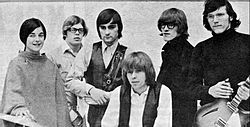
Jefferson Airplane in early 1966. From left: Anderson, Casady, Balin, Spence, Kantner and Kaukonen.
After rehearsing throughout the summertime, the group made its first public appearance every bit Jefferson Plane at the opening night of The Matrix on Baronial 13, 1965.[six] [xx] The band expanded from its folk roots, drawing inspiration from the Beatles, the Byrds and the Lovin' Spoonful, and gradually adult a more popular-oriented electric sound.[ commendation needed ] Later that month, John L. Wasserman of the San Francisco Chronicle praised the band'due south "musical approach and fashion"—noting their blend of folk, blues, and rock and curlicue—and remarked, "Although at that place are but hints at this time, it is entirely possible that this will be the new management of contemporary pop music."[21]
A few weeks after the group started performing, Jerry Peloquin departed because of conflicts with his bandmates, in role because of his disdain for the others' drug utilise.[22] Although he was not a drummer, singer-guitarist Skip Spence (who after co-founded Moby Grape) was then invited to supersede Peloquin.[23] Spence quickly adapted and made his debut at the Matrix in September.[24] In October 1965, after the other members decided that Bob Harvey's bass playing was not up to par, he was replaced by guitarist-bassist Jack Casady, an sometime friend of Kaukonen from Washington, D.C.[25] Casady played his first gig with the Airplane at a college concert in Berkeley, California, two weeks after he arrived in San Francisco.[ citation needed ]
The group's performing skills improved rapidly and they soon gained a strong following in and effectually San Francisco, aided by reviews from veteran music journalist Ralph J. Gleason, the jazz critic of the San Francisco Relate. Afterward seeing them at the Matrix, Gleason wrote in the September 13th edition of his "On the Town" column that the band, still without a record bargain, would "obviously tape for someone" eventually.[22] Gleason's back up raised the ring's profile considerably, and inside three months Katz was fielding offers from recording companies, although they had notwithstanding to perform exterior the Bay Surface area.[22]

Jefferson Airplane Fillmore poster, February 1966. This was the first non-benefit concert held at the venue.[26]
Two pregnant early on concerts featuring the Plane were held in late 1965. The first was the celebrated dance at the Longshoremen's Hall in San Francisco on October sixteen, 1965, the first of many "happenings" in the Bay Expanse, where Gleason first saw them perform. At this concert they were supported by a local folk-rock group, the Great Society, which featured Grace Slick as atomic number 82 vocaliser and it was here that Kantner met Slick for the first fourth dimension.[27] A few weeks later on, on November six, they headlined a benefit concert for the San Francisco Mime Troupe, the get-go of many promotions past rising Bay Area entrepreneur Bill Graham, who afterward became the ring's manager.
By late 1965, Jefferson Airplane, under Katz'south direction, had turned downward recording offers from Capitol, Valiant, Fantasy, Elektra, and London.[28] In November 1965, Jefferson Aeroplane signed a recording contract with RCA Victor, which included a then unheard-of advance of U.s.$25,000.[29] Before this, they had recorded a demo for Columbia Records of "The Other Side Of This Life" with Bob Harvey on bass, which was immediately rejected by the characterization.[28] On December ten, 1965, the Airplane played at the kickoff Bill Graham-promoted evidence at the Fillmore Auditorium, supported past the Cracking Society and others. The Plane also appeared at numerous Family Dog shows promoted by Chet Helms at the Avalon Ballroom.[27]

The group in mid-1966 after Spencer Dryden replaced Skip Spence on drums.
The grouping'south start single was Balin's "It's No Clandestine" (a tune he wrote with Otis Redding in mind); the B-side was "Runnin' Circular the World", the song that led to the ring'due south start clash with RCA Victor over the lyric "The nights I've spent with y'all have been fantastic trips". Later their debut LP was completed in March 1966, Skip Spence quit the band and he was eventually replaced by Spencer Dryden, who played his get-go show with the Airplane at the Berkeley Folk Festival on July four, 1966. Dryden had previously played with a Los Angeles group called the Ashes, who later became the Peanut Butter Conspiracy.[xxx]
Original director Katz was fired in Baronial, sparking a long-running legal battle that continued until 1987, and Balin's friend and roommate Bill Thompson was installed as road manager and temporary band manager. Information technology was Thompson, a friend and staunch supporter of the band and a one-time Chronicle staffer, who had convinced reviewers Ralph Gleason and John Wasserman to meet the band at the Longshoreman'southward Hall. Thanks to Gleason'south influence, Thompson was able to book the grouping for appearances at the Berkeley Folk Festival and at the Monterey Jazz Festival.[ citation needed ]
The group'southward debut LP Jefferson Plane Takes Off was released in September 1966. The folk-music-influenced album included John D. Loudermilk'south "Tobacco Route" and Dino Valente's "Let'south Gather",[27] every bit well as original ballads "Information technology's No Secret" and "Come Up the Years". Despite the fact that the grouping had neither performed outside the Bay Area nor appeared on Television, the album garnered considerable attention in the Usa and sold well enough to earn a gold tape award. RCA Victor initially pressed only fifteen,000 copies, only information technology sold more 10,000 in San Francisco lonely, prompting the label to reprint it. For the re-pressing, the company deleted "Runnin' Round This World" (which had appeared on early mono pressings), because executives objected to the word "trip" in the lyrics. For similar reasons, RCA Victor substituted altered versions for ii other tracks: "Let Me In", irresolute the line "I gotta get in/you know where" to "you shut your door/now it ain't fair." In the same song, they likewise switched the lyric "Don't tell me you want money" to "Don't tell me information technology ain't funny". "Run Around" was also edited, irresolute the line "flowers that sway equally you lay under me" to "flowers that sway as you stay here past me". The original pressings of the LP featuring "Runnin' 'Circular This Globe" and the uncensored versions of "Let Me In" and "Run Effectually" are at present worth thousands of dollars on the collectors' market.[ citation needed ]
Signe Anderson gave birth to her daughter in May 1966,[xi] and in October she announced her departure from the band. Her final performance with the Airplane took place at the Fillmore on October 15, 1966.[31] A recording of the performance was in 2010 released every bit a live anthology, subtitled Signe's Farewell.[32]
1966–1967: Commercial quantum [edit]
The post-obit night, Anderson's replacement Grace Slick made her first advent. Slick was already well known to the band—she had attended the Aeroplane's debut gig at the Matrix in 1965 and her previous group, the Cracking Society, had often supported the Aeroplane in concert.
Slick's recruitment proved pivotal to the Aeroplane's commercial quantum—she possessed a powerful and supple contralto vocalisation that complemented Balin's and was well-suited to the grouping's amplified psychedelic music, and, a quondam model, her expert looks and stage presence greatly enhanced the group's alive affect. "White Rabbit" was written past Grace Slick while she was still with The Bully Guild. The beginning album Slick recorded with Jefferson Aeroplane was Surrealistic Pillow, and Slick provided two songs from her previous group: her own "White Rabbit" and "Somebody to Beloved", written by her brother-in-law Darby Slick. Both songs became breakout successes for Jefferson Airplane and have ever since been associated with that ring.[33]
The Great Society had recorded an early version of "Somebody to Love" (under the title "Someone to Love") as the B-side of their only unmarried, "Costless Advice", produced by Sylvester Stewart (soon to become famous as Sly Stone). It reportedly took more than 50 takes to reach a satisfactory rendition. The Peachy Society decided to divide in late 1966 and played its concluding show on September 11. Soon after, Slick was asked to join Jefferson Aeroplane by Jack Casady (whose musicianship was a major influence on her decision) and her Dandy Social club contract was bought out for $750.[33]
In December 1966, Jefferson Plane was featured in a Newsweek article most the booming San Francisco music scene, one of the first in a welter of similar media reports that prompted a massive influx of young people to the city and contributed to the commercialization of the hippie culture.
Effectually the beginning of 1967 Nib Graham took over from Bill Thompson as manager. In January the group fabricated their first visit to the East Coast. On January fourteen, alongside the Grateful Dead and Quicksilver Messenger Service, Jefferson Aeroplane headlined the "Human Be-In", the famous all-day "happening" in Gilded Gate Park, one of the key events leading upward to the "Summer of Love".
During this flow the band gained their first international recognition when rising British pop star Donovan, who saw them during his stint on the U.South. W Coast in early 1966, mentioned the Plane in his song "The Fat Affections", which subsequently appeared on his Sunshine Superman LP.
The grouping's second LP, Surrealistic Pillow, recorded in Los Angeles with producer Rick Jarrard in only thirteen days at a price of $8,000, launched the Airplane to international fame. Released in February 1967, the LP entered the Billboard 200 album nautical chart on March 25 and remained there for over a year, peaking at No. iii. It sold over one one thousand thousand copies, and was awarded a golden disc.[34] The proper noun "Surrealistic Pillow" was suggested by the album'due south "shadow producer," Jerry Garcia, when he mentioned that, equally a whole, the album sounded "equally surrealistic as a pillow is soft." Although RCA would non acknowledge Garcia'due south considerable contributions to the anthology with a product credit, he is listed in the album's credits as "spiritual advisor."
In addition to the group's two best-known tracks, "White Rabbit" and "Somebody to Dearest", the anthology featured "My Best Friend" by old drummer Skip Spence, Balin'due south driving blues-rock songs "Plastic Fantastic Lover" and "three/5 of a Mile in 10 Seconds", and the atmospheric Balin-Kantner carol "Today". A reminder of their earlier folk incarnation was Kaukonen'south solo audio-visual guitar bout de force, "Embryonic Journey" (his first limerick), which referenced gimmicky acoustic guitar masters such as John Fahey and helped to establish the popular genre exemplified past acoustic guitarist Leo Kottke.
The first single from the album, Spence's "My Best Friend", failed to chart, just the next two singles rocketed the group to prominence. Both "Somebody to Dearest" and "White Rabbit" became major U.S. hits, the former reaching No. 5 and the latter No. 8 on the Billboard singles chart. Past late 1967 the Airplane were national and international stars and had become one of the hottest groups in America. Grace Slick biographer Barbara Rowes called the album "a declaration of independence from the establishment [-] What Airplane originated was a romanticism for the electronic age. Dissimilar the highly homogenized harmonies of the Embankment Boys, Airplane never strived for a synthesis of its divergent sensibilities. Through [-] each song, there remain strains of the private styles of the musicians [creating] unusual breadth and original interplay within each construction".[35]
This phase of the Plane's career peaked with their famous performance at the Monterey International Pop Festival in June 1967. Monterey showcased leading bands from several major music "scenes" including New York, San Francisco, Los Angeles, and the United Kingdom, and the resulting TV and film coverage gave national (and international) exposure to groups that had previously had simply regional fame. Two songs from the Airplane'south set up were after included in the D. A. Pennebaker flick documentary of the effect.
In August 1967, the Airplane performed in Montreal, Quebec, Canada, at two free outdoor concerts, along with fellow San Francisco Bay Surface area band The Grateful Dead. The kickoff concert was held in downtown Montreal at Place Ville Marie, and the second was at the Youth Pavilion of Expo 67.[36]
The Airplane also benefited profoundly from appearances on national network Telly shows such equally The Tonight Bear witness Starring Johnny Carson on NBC and The Ed Sullivan Show on CBS. The Airplane's famous appearance on The Smothers Brothers Comedy Hour performing "White Rabbit" and "Somebody to Beloved" was videotaped in color and augmented by developments in video techniques. It has been often re-screened and is notable for its pioneering employ of the Chroma key process to simulate the Airplane'southward psychedelic lite show.[ citation needed ]
1967–1970: Heavier sound and improvisation [edit]
After Surrealistic Pillow, the group's music underwent a significant transformation. Key influences on the group'due south new management were the popularity and success of Jimi Hendrix and the British supergroup Cream, which prompted the Airplane (like many other groups) to prefer a "heavier" sound and to place a greater emphasis on improvisation. The ring'south third LP, After Bathing at Baxter's, was released on Nov 27, 1967, and somewhen peaked in the charts at No. 17. Its famous cover, drawn by renowned artist and cartoonist Ron Cobb, depicts a Heath Robinson-inspired flying machine (synthetic around an idealised version of a typical Haight-Ashbury district house) soaring above the chaos of American commercial civilization.
Recorded over a period of more than than iv months, with lilliputian input from nominal producer Al Schmitt, the new anthology demonstrated the group's growing date with psychedelic rock. Where the previous LP had consisted entirely of "standard-length" pop songs, Baxter's was dominated past long multi-function suites, while "A Modest Package of Value Will Come To You Before long" was a musique concrète-style audio collage.
Baxter's also marked the ascendency of Kantner and Slick as the ring's principal composers and the concurrent reject in the influence and interest of founder Marty Balin. The other members, gravitating toward a harder-edged style, openly criticized Balin for his ballad-oriented compositions. Balin was also reportedly becoming increasingly disenchanted with the "star trips" and inflated egos generated by the band's runaway commercial success.
In dissimilarity to "White Rabbit" and "Somebody To Love", "The Ballad of Yous and Me and Pooneil" but peaked at No. 42 and "Watch Her Ride" stalled at No. 61. Both singles did reach the Top twoscore in Cash Box, however. None of the ring'south subsequent singles reached the Billboard Top 40 and several failed to chart at all. AM Top xl radio became wary of a group that had scored a striking with a song that independent thinly veiled drug references and whose singles were often deemed too controversial, so Jefferson Airplane never again enjoyed the kind of widespread AM radio support that served every bit a prerequisite for Pinnacle Ten hits.[37]
In Feb 1968, manager Pecker Graham was fired afterward Grace Slick delivered an "either he goes or I get" ultimatum.[38] Bill Thompson took over as permanent director and fix almost consolidating the grouping's financial security, establishing Icebag Corp. to oversee the ring's publishing interests and purchasing a 20-room mansion at 2400 Fulton Street across from Golden Gate Park nigh the Haight-Ashbury, which became the band's part and communal residence. Bill Laudner was hired as route manager.
In mid-1968, the group was photographed for a Life magazine story on "The New Rock", actualization on the cover of the June 28, 1968 edition. They undertook their first major tour of Europe in Baronial–September 1968, playing alongside the Doors in the Netherlands, England, Germany, and Sweden.[38] In a notorious incident at a concert in Amsterdam, while the Airplane was performing "Plastic Fantastic Lover", Doors singer Jim Morrison, under the influence of a combination of drugs fans had given him, appeared on stage and began dancing "similar a pinwheel". As the group played faster and faster, Morrison spun around wildly until he finally vicious senseless on the stage at Marty Balin'south feet. Morrison was unable to perform his fix with the Doors and was hospitalized while keyboardist Ray Manzarek was forced to sing all the vocals.[39] It was also during this tour that Slick and Morrison allegedly engaged in a brief sexual human relationship, described in Somebody To Love?, Slick's 1998 autobiography.
Jefferson Plane'southward fourth LP, Crown of Creation (released in September 1968), was a commercial success, peaking at No. 6 on the album nautical chart and receiving a gilt certification. Grace Slick'southward "Lather", which opens the album, is said to be nearly her affair with drummer Spencer Dryden and his 30th birthday.[38] "Triad", a David Crosby composition,[27] had been rejected by The Byrds considering they accounted its subject matter (a ménage à trois) to be too "hot." Slick's searing sexual and social-commentary anthem "Greasy Center" was released every bit a single in March 1968. A few tracks recorded for the LP were left off the anthology but subsequently included as bonus tracks, including the Grace Slick/Frank Zappa collaboration "Would You Similar A Snack?"
The Airplane's appearance on The Smothers Brothers Comedy Hour in the autumn of that yr caused a minor stir when Grace Slick appeared in greasepaint (she claimed she simply wanted to clothing all the makeup she saw in her dressing room) and raised her fist in the Black Panther Party's salute afterward singing "Crown of Creation".
In November 1968, the band played "House at Pooneil Corners" on a New York City rooftop. It was filmed for D. A. Pennebaker moving-picture show 1 PM. The concert was stopped by the police merely similar the Beatles' famous rooftop concert about two months later, as depicted in the 1970 documentary Let It Be.
In February 1969, RCA released the live album Bless Its Pointed Little Head, which was culled from 1968 performances at the Fillmore West on October 24–26 and the Fillmore Eastward on November 28–30. Information technology became the Aeroplane'due south fourth Meridian 20 anthology, peaking at No. 17.
Hot Tuna began during a break in Jefferson Airplane'south touring schedule in early on 1969 while Grace Slick recovered from throat node surgery that left her unable to perform. Kaukonen, Casady, Kantner and drummer Joey Covington played several shows effectually San Francisco, including the Airplane's original club, The Matrix, before Jefferson Airplane resumed performing. Their early on repertoire derived mainly from Airplane material that Kaukonen (the band's frontman) sang and covers of American country blues artists such equally Reverend Gary Davis, Jelly Coil Morton, Bo Carter and Blind Blake. In addition, Casady and Kaukonen played equally a duo nether the moniker with Kaukonen on acoustic guitar and Casady on electric bass. From October 1969 to November 1970, Hot Tuna (likewise including Balin and, following Kantner'southward departure, a dedicated rhythm guitarist in their electric performances until November 1970) performed as the opening act to Jefferson Airplane with a combination of both electric and audio-visual sets.
In April 1969, sessions began for their adjacent anthology, Volunteers, using new 16-track facilities at the Wally Heider Studio in San Francisco. This proved to be the final anthology by the "archetype" lineup of the group. The album'south release was delayed when the band ran into conflict with their label over the content of songs such equally "We Can Exist Together" and the planned championship of the album, Volunteers of Amerika. "Volunteers of Amerika" is a corruption of the Volunteers of America clemency, the term being in faddy in 1969 as an ironic expression of dissatisfaction with America; after the charity objected, the name was shortened to Volunteers.[40]
A few days after the band headlined at a costless concert in New York'south Central Park in August 1969, they performed in what Grace Slick characterized as the "forenoon maniac music" slot at the Woodstock Festival, for which the grouping was joined by noted British session keyboard histrion Nicky Hopkins. When interviewed about Woodstock by Jeff Tamarkin in 1992, Paul Kantner still recalled it with fondness, whereas Grace Slick and Spencer Dryden had less than rosy memories.[41]
Immediately after their Woodstock performance, the ring appeared on The Dick Cavett Show and played a few songs. Other guests on that same episode were David Crosby, Stephen Stills, and Joni Mitchell.[42] The new album was finally released in the U.s.a. in Nov 1969 with the championship shortened to Volunteers. The anthology continued the Aeroplane'southward run of Top 20 LPs, peaking at No. 13 and attaining a RIAA gilt certification early in 1970. Information technology was their near political venture, showcasing the group's song opposition to the Vietnam War and documenting their reaction to the changing political atmosphere in the United states. The best-known tracks include "Volunteers," "Nosotros Can Be Together," "Good Shepherd," and the post-apocalyptic "Wooden Ships," which Paul Kantner co-wrote with David Crosby and Stephen Stills, and which Crosby, Stills & Nash besides recorded on their debut album.[43]
RCA raised objections to the phrase "up confronting the wall, motherfucker" in the lyrics of Kantner's "Nosotros Tin can Be Together", but the grouping managed to forbid information technology from being censored on the anthology, pointing out that RCA had already allowed the offending word to be included on the cast anthology of the rock musical Hair. In addition, the song had the line "in order to survive, we steal, crook, prevarication, forge, fuck, hibernate, and deal", which was too kept on the anthology (and which they sang on circulate TV during their Dick Cavett appearance). For the single versions of "We Tin can Be Together," "motherfucker" was changed to a long, drawn out "Ma," and "fuck" was changed to "fred." These edits were reflected in the printed lyrics that accompanied the album.
In September 1969, Kaukonen and Casady played a calendar week of acoustic-based concerts at the New Orleans House in Berkeley, California, as Hot Tuna; recordings culled from this engagement were released every bit the ring's eponymous debut album in 1970. This initial Hot Tuna album was remarkably successful, reaching No. 30 on the U.S. album nautical chart. Over the next two years, the various configurations of Hot Tuna began to occupy more and more of Casady's and Kaukonen's time, contributing to the growing divisions within Jefferson Airplane that came to a head in 1972.
In December 1969, the Airplane played at the Altamont Complimentary Concert at Altamont Speedway in California. Following the Grateful Expressionless'southward withdrawal from the program,[44] they became the only band to perform at all 3 of the iconic rock festivals of the 1960s—Altamont, Monterey Popular, and Woodstock. Headlined by The Rolling Stones, the concert was marred by violence. Marty Balin was knocked out during a scuffle with Hells Angels members who had been hired to human activity equally "security."[45] The event became notorious for the fatal stabbing of blackness teenager Meredith Hunter in forepart of the phase by Hells Angels "guards" afterwards he pulled out a revolver during the Stones' performance. This incident was the centerpiece of the documentary film Gimme Shelter.
1970–1974: Decline and dissolution [edit]
Spencer Dryden was dismissed from the ring in February 1970 past a unanimous vote of the other members.[46] He felt burned out by iv years on the "acrid merry-go-round" and was deeply disillusioned by the events of Altamont, which, he later recalled, "did not expect like a bunch of happy hippies in streaming colors. It looked more like sepia-toned Hieronymus Bosch." He took fourth dimension off earlier returning to music the following year as Mickey Hart's replacement in the New Riders of the Regal Sage. Dryden was replaced by Hot Tuna drummer Joey Covington, who had already contributed additional percussion to Volunteers and performed select engagements with the Airplane as a touring 2nd drummer in 1969. Later that yr, the band was further augmented by the addition of veteran jazz violinist Papa John Creach, a friend of Covington who officially joined Hot Tuna and Jefferson Aeroplane for their fall tour in October 1970.
Touring connected throughout 1970, but the group's only new recordings that year were the single "Mexico" backed with the B-side "Take You Seen the Saucers?". Slick'southward "Mexico" was an attack on President Richard Nixon's Operation Intercept, which had been implemented to curtail the menstruation of marijuana into the United States. "Have You Seen the Saucers" marked the beginning of the science fiction themes that Kantner explored in much of his subsequent work, including Blows Against the Empire, his commencement solo album. Released in November 1970 and credited to "Paul Kantner/Jefferson Starship," this prototypical iteration of Jefferson Starship (alternatively known as the Planet Globe Rock and Whorl Orchestra) included David Crosby and Graham Nash; Grateful Dead members Jerry Garcia, Pecker Kreutzmann, and Mickey Hart; session luminary Harvey Brooks; David Freiberg; and Slick, Covington and Casady. Blows Against the Empire peaked at No. twenty in the Usa and was the start rock album nominated for the Hugo Honour.
Jefferson Plane ended 1970 with their traditional Thanksgiving Twenty-four hours engagement at the Fillmore Due east (mark the final performances of the short-lived Creach-era septet) and the release of their offset compilation album, The Worst of Jefferson Airplane, which continued their unbroken run of post-1967 chart success, reaching No. 12 on the Billboard album chart.
1971 was a year of major upheaval for Jefferson Aeroplane. Grace Slick and Paul Kantner had begun a human relationship during 1970, and on January 25, 1971, their daughter China Wing Kantner ("Fly" was Slick's maiden name) was built-in.[47] [48] Slick's divorce from her first husband had come through soon earlier this, simply she and Kantner agreed that they did not wish to ally.
In Apr 1971, Marty Balin officially left Jefferson Airplane after disassociating himself from the group post-obit the autumn 1970 bout. Although he had remained a key office of live performances after the ring's creative direction shifted from the brooding love songs that he specialized in, the evolution of the polarized Kantner/Slick and Kaukonen/Casady cliques—compounded by an emerging drinking trouble—had finally left him the odd man out. Following the traumatic death of Janis Joplin, he began to pursue a healthier lifestyle; Balin's written report of yoga and abstention from drugs and alcohol further distanced him from the other members of the group, whose drug intake continued unabated. This further complicated the recording of their long-overdue follow-up to Volunteers; Balin had recently completed several new songs, including "Emergency" and the elongated R&B-infused "Yous Wear Your Dresses Besides Curt," both of which later appeared on archival releases.
On May xiii, 1971, Grace Slick was injured in a near-fatal automobile crash when her car slammed into a wall in a tunnel near the Golden Gate Bridge in San Francisco. The accident happened while she was elevate racing with Jorma Kaukonen; both were driving at over 100 miles per hour, and Kaukonen claims that he "saved her life" by pulling her from the car.[49] Slick'south recuperation took a few months, forcing the Airplane to curtail their touring commitments. In the meantime, Slick recorded a comic song ("Never Argue with a High german If You're Tired or European Song") about the incident for the new album.
In September 1971, Bawl was released. With comprehend fine art depicting a dead fish wrapped in an A&P-style grocery bag, it was both the final album owed to RCA under the band'due south existing contract and the inaugural release on the ring'south Grunt Records vanity label. Manager Bill Thompson had struck a deal with RCA to let Jefferson Airplane to run Grunt Records as they saw fit while retaining RCA'due south distribution. The single "Pretty As Y'all Feel", excerpted from a longer jam with members of Santana and featuring atomic number 82 vocals by Joey Covington, its principal composer, was the last Jefferson Airplane chart hit, peaking at No. 60 in Billboard and No. 35 in Cashbox. The album rose to No. xi in Billboard, higher than Volunteers, Blows Against the Empire and Hot Tuna'south second album, Starting time Pull Up, Then Pull Down, released iii months earlier Bark in June.
In spite of the band's continued success, major creative and personal divisions persisted betwixt the Slick/Kantner and Kaukonen/Casady factions. (Kaukonen's "Third Week In The Chelsea," from Bawl, chronicles the thoughts he was having about leaving the band.) These problems continued to be exacerbated by the band's escalating cocaine use and Slick's alcohol use disorder. Consequently, while the ring played several dates in Baronial in back up of Bark (including 2 concerts in the New York metropolitan surface area and a evidence apiece in Detroit and Philadelphia), no tour was planned. Following a private concert/political party commemorating the formation of Grunt Records at San Francisco's Friends and Relations Hall in September, the band would not reconvene until several Midwestern engagements in January 1972.
Jefferson Airplane held together long enough to record one more album, entitled Long John Silver, begun in Apr 1972 and released in July. By this time the various members were thoroughly engaged with their various solo projects. Post-obit the release of Kantner and Slick's Sunfighter in November 1971 and Creach'south eponymous solo debut in December 1971, Hot Tuna released their first studio album and third opus (Burgers) in February 1972; meanwhile, Joey Covington immersed himself in various Grunt Records projects, including his own solo album (Fat Fandango, released in 1973) and the sessions for Black Kangaroo'south debut album (led past multi-instrumentalist Peter Kaukonen, Jorma's younger blood brother). Nevertheless, Covington was either dismissed from the band or left of his own volition shortly after the sessions commenced.
With Hot Tuna drummer Sammy Piazza deputizing on one track, Covington (who had already recorded two drum parts) was soon replaced past former Turtles/CSNY drummer John Barbata, who ultimately played on most of the album. Long John Silverish is notable for its cover, which folded out into a humidor, which the inner photo depicted as storing cigars (which may have been filled with marijuana). Despite middling reviews, the album rose to No. 20 in the United States, a significantly higher placement than Burgers (No. 68) or Sunfighter (No. 89).
The ring began a proper national tour to promote Long John Silver in the summertime of 1972, their first in nigh two years. Shortly before the tour commenced, David Freiberg (who had recently completed a prison house sentence for marijuana possession afterward leaving Quicksilver Messenger Service) joined equally a belated replacement for Balin. The East Coast leg of the tour included a major free concert in Cardinal Park that drew over 50,000 attendees. They returned to the W Coast in September, playing concerts in San Diego, Hollywood, Phoenix and Albuquerque. The tour culminated in two shows at the Winterland Ballroom in San Francisco (September 21–22), both of which were recorded. At the end of the second show, the group was joined on stage by Marty Balin, who sang lead vocals on "Volunteers" and the terminal song, "Y'all Vesture Your Dresses Too Short".
The Winterland shows were the last live performances by Jefferson Airplane[22] until their reunion in 1989. A new live album, Xxx Seconds Over Winterland, was culled from the tour and released in April 1973. Later that twelvemonth, Kaukonen and Casady decided to focus on Hot Tuna as a full-time attempt, finer leaving the band; however, no official announcement was ever released. By December 1973, RCA had terminated the band's salaries, resulting in Freiberg being forced to draw unemployment to maintain his firm payments.[50]
Following the commercially unsuccessful Baron von Tollbooth & the Chrome Nun (1973; credited to Kantner, Slick and Freiberg) and Manhole (1974; credited to Slick), Jefferson Airplane evolved into Jefferson Starship in Jan 1974.[51] [52] [53] [54] The initial lineup consisted of the remaining members of Jefferson Airplane (Kantner, Slick, Freiberg, Barbata, Creach); bassist Peter Kaukonen (before long replaced by British multi-instrumentalist Pete Sears, a veteran of Creach's debut solo album and Manhole); and lead guitarist Craig Chaquico, a member of Grunt Records ring Jack Traylor and Steelwind who contributed to the Kantner/Slick solo albums beginning with Sunfighter. They appropriated the name from Kantner's Blows Against the Empire, with Bill Thompson convincing the group that maintaining the connection was prudent from a business standpoint.[55] Reflecting the transition, the album Dragon Fly, released in September 1974, was credited to Slick, Kantner and Jefferson Starship.
Side projects and spin-off bands [edit]
Reunion and recent events [edit]
Later the acrimonious events that resulted in Jefferson Starship'south 1984 evolution into Starship, Kantner reunited with Balin (who joined Jefferson Starship in January 1975 following a guest appearance on Dragon Fly before leaving one time more in 1978) and Jack Casady in 1985 to grade the KBC Band. They released their but album, KBC Band, in 1986 on Arista Records. On March 4, 1988, Grace Slick made a cameo appearance during a Hot Tuna San Francisco performance at the Fillmore (with Kantner and Creach joining in), facilitating a potential reunion of Jefferson Airplane.
In 1989, the classic 1966–1970 lineup of Jefferson Plane reunited (with the exception of drummer Spencer Dryden) for a bout and anthology. The self-titled album was released by Ballsy[56] to modest sales merely the accompanying tour was considered a success.[53]
In 1996, the 1966–1970 lineup of Jefferson Airplane was inducted into the Rock and Scroll Hall of Fame, with Balin, Casady, Dryden, Kantner and Kaukonen attending too equally performing. Grace Slick was absent-minded, every bit she was unable to travel for medical reasons.[57]
1998 saw the production and circulate of a very pop episode of the striking VH1 documentary television series Behind The Music about Jefferson Airplane, directed by Bob Sarles. Band members Grace Slick, Marty Balin, Paul Kantner, Jorma Kaukonen, Jack Casady and Spencer Dryden were all interviewed for the episode, forth with David Crosby, longtime Aeroplane managing director Bill Thompson and Red china Kantner, daughter of Paul Kantner and Grace Slick.[58]
In 2004, the film Fly Jefferson Plane (directed by Bob Sarles) was released on DVD.[59] It covers the years 1965–1972 and includes then-recent interviews with band members and xiii complete songs.
Spencer Dryden died of colon cancer on January 11, 2005.[threescore]
Jorma Kaukonen and Jack Casady performed a set at the 2015 Lockn' Festival to gloat the 50th anniversary of Jefferson Airplane. They were joined by G.Eastward. Smith, Rachael Price, Larry Campbell and Teresa Williams.[61] In 2016, Jefferson Airplane was given the Grammy Lifetime Accomplishment Award.[62]
Both Signe Anderson and Paul Kantner died on Jan 28, 2016.[63]
Marty Balin died on September 27, 2018.[64]
Members [edit]
- Paul Kantner – rhythm guitar, vocals (1965–1972, 1989, 1996; died 2016)
- Jorma Kaukonen – lead guitar, vocals (1965–1972, 1989, 1996)
- Marty Balin – vocals, rhythm guitar, percussion (1965–1971, 1989, 1996; died 2018)
- Signe Toly Anderson – vocals (1965–1966; died 2016)
- Bob Harvey – double bass (1965)
- Jerry Peloquin – drums (1965)
- Skip Spence – drums, percussion (1965–1966; died 1999)
- Jack Casady – bass, rhythm guitar (1965–1972, 1989, 1996)
- Grace Slick – vocals, piano, recorder, keyboards (1966–1972, 1989)
- Spencer Dryden – drums, percussion (1966–1970, 1996; died 2005)
- Joey Covington – drums, percussion (1970–1972; died 2013)
- Papa John Creach – violin, vocals (1970–1972; died 1994)
- John Barbata – drums, percussion (1972)
- David Freiberg – vocals, rhythm guitar (1972)
Discography [edit]
- Jefferson Airplane Takes Off (1966)
- Surrealistic Pillow (1967)
- Subsequently Bathing at Baxter's (1967)
- Crown of Creation (1968)
- Volunteers (1969)
- Bawl (1971)
- Long John Silver (1972)
- Jefferson Aeroplane (1989)
Run across also [edit]
References [edit]
Citations [edit]
- ^ a b Stutz, Colin (January 28, 2016). "Paul Kantner, Jefferson Airplane Co-Founder & Guitarist, Dies at 74". Billboard.com. Archived from the original on November 30, 2017. Retrieved October 27, 2017.
- ^ "500 Greatest Songs of All Time". Rolling Stone. April 7, 2011. Archived from the original on April 6, 2019. Retrieved August 4, 2020.
- ^ Lewis, Randy (September 28, 2018). "Marty Balin, co-founder of Jefferson Aeroplane, dies at 76". Los Angeles Times. Archived from the original on July x, 2019. Retrieved July 9, 2019.
- ^ Tamarkin 2003, p. 11.
- ^ uao (June five, 2005). "Artist Overview – Jefferson Airplane". Blogcritics Music. Archived from the original on July 28, 2011. Retrieved October ii, 2011.
- ^ a b Ruhlmann, William. "Jefferson Airplane: Artist Biography". AllMusic. Archived from the original on July four, 2018. Retrieved July 6, 2017.
- ^ Tamarkin 2003, p. 24.
- ^ a b c Butterworth 2021, p. 15.
- ^ Unterberger, Richie. "David Freiberg". Allmusic. Archived from the original on October 11, 2017.
- ^ a b Tamarkin 2003, p. 23.
- ^ a b Unterberger, Richie. "Signe Anderson Biography". AllMusic. Archived from the original on March 8, 2016. Retrieved January 11, 2019.
- ^ Tamarkin 2003, p. 25.
- ^ a b Tamarkin 2003, p. 32.
- ^ "Jorma Kaukonen: A Brief History". JormaKaukonen.com. Archived from the original on November 27, 2009. Retrieved August 25, 2007.
- ^ Leonardi, Tom (October 5, 2016). "Music by local legend Richmond Talbot". KZFR. Archived from the original on February 23, 2020. Retrieved February 24, 2022.
- ^ Butterworth 2021, pp. 15–16.
- ^ a b Tamarkin 2003, p. 33.
- ^ Tamarkin 2003, p. 36.
- ^ Tamarkin 2003, pp. 60–61.
- ^ Tamarkin 2003, pp. 39–40.
- ^ Tamarkin 2003, p. 40–41.
- ^ a b c Tamarkin 2003, p. 41.
- ^ Tamarkin 2003, p. 42.
- ^ Tamarkin 2003, p. 43.
- ^ Tamarkin 2003, pp. 45, 49, 51.
- ^ "Fillmore History". The Fillmore. Archived from the original on May v, 2006. Retrieved June 13, 2011.
- ^ a b c d Gilliland, John (1969). "Show 41 – The Acid Test: Psychedelics and a sub-culture emerge in San Francisco" (audio). Pop Chronicles. Academy of North Texas Libraries. Archived from the original on November 9, 2011. Retrieved April 29, 2011.
- ^ a b Tamarkin 2003, p. 44.
- ^ Butterworth 2021, p. sixteen.
- ^ "The Peanut Butter Conspiracy - The Unofficial Web Site". www.peanutbutterconspiracy.com. Archived from the original on March 4, 2021. Retrieved April 13, 2021.
- ^ Kreps, Daneil (January 31, 2016). "Signe Anderson, Original Jefferson Plane Singer, Expressionless at 74". Rolling Stone. Archived from the original on July 17, 2016. Retrieved July 4, 2016.
- ^ Ruhlmann, William. "Live at the Fillmore Auditorium x/15/66: Belatedly Bear witness: Signe'southward Farewell". AllMusic. Archived from the original on December 5, 2017. Retrieved September fifteen, 2019.
- ^ a b Tamarkin 2003, p. 113.
- ^ Murrells, Joseph (1978). The Book of Golden Discs (2nd ed.). London: Barrie and Jenkins Ltd. p. 224. ISBN0-214-20512-half-dozen.
- ^ Rowes, Barbara (1980). Grace Slick. Doubleday. p. 74. ISBN0-385-13390-ane.
- ^ Whelan, John. "August half-dozen, 1967: Jefferson Plane and the Grateful Dead performed at the Youth Pavilion at Expo 67". Expo 67 in Montreal. Archived from the original on October five, 2020. Retrieved October 27, 2017.
- ^ Ruhlmann, William. "Yahoo! Music – Jefferson Airplane biography". Music.yahoo.com. Archived from the original on September v, 2008. Retrieved October 2, 2011.
- ^ a b c Tamarkin 2003.
- ^ The Doors: Live in Europe 1968. A*Vision Entertainment. 1991.
- ^ Tamarkin 2003, p. 197.
- ^ Allen, Gavin (November xviii, 2009). "Paul Kantner talks Woodstock, Jefferson Starship and smashed cars". South Wales Echo. Archived from the original on October thirteen, 2012. Retrieved Dec 5, 2010.
- ^ The Dick Cavett Testify: Rock Icons. Daphne Productions, Inc. 2005.
- ^ Gallucci, Michael (January 28, 2016). "Top ten Jefferson Airplane Songs". Ultimate Classic Rock. Archived from the original on May 17, 2021. Retrieved May 17, 2021.
- ^ Lydon, Michael (September 1970). "An Evening with the Grateful Dead". Rolling Rock.
- ^ "Interview: Paul Kantner". Music-Illumanati. April 25, 2010. Archived from the original on November 13, 2010. Retrieved December 5, 2010.
- ^ Tamarkin 2003, p. 216.
- ^ "Names In The News". Tri-City Herald. Kennewick, Washington. January 26, 1971. Retrieved December five, 2010.
{{cite news}}: CS1 maint: url-status (link) - ^ "Daughter Born To Pop Vocalizer". The Day. Vol. xc, no. 172. New London, Connecticut. Jan 26, 1971. p. 11. Archived from the original on December 22, 2015. Retrieved December v, 2010.
- ^ Tamarkin 2003, p. 239–240.
- ^ Snyder, Patrick (Jan one, 1976). "Jefferson Starship: The Miracle Rockers". Rolling Rock. Archived from the original on October 28, 2017. Retrieved Oct 27, 2017.
- ^ "Jefferson Airplane". Stone & Roll Hall of Fame. Archived from the original on August 19, 2017. Retrieved October 27, 2017.
- ^ "The Core: Jefferson Aeroplane". Relix.com. Relix Media Group LLC. December eleven, 2019. Archived from the original on December 18, 2019. Retrieved December 29, 2019.
Paul and I didn't know what was going on because Jack and Jorma took off to one of the Scandinavian countries to do some speed-skating. They didn't call back, and they were just gone. And then Paul and I started making records as Jefferson Starship. We had to rename it because you couldn't call it Airplane unless all of the original members were making the record.
- ^ a b DeRiso, Nick (July eighteen, 2019). "Why Jefferson Plane'due south Unexpected Reunion Crash Landed". Ultimate Archetype Stone. Loudwire. Archived from the original on Apr 22, 2020. Retrieved August 4, 2020.
The original group had released a serial of era-defining anti-establishment projects in the late '60s before morphing into Jefferson Starship, a far less political outfit.
- ^ Plantier, Boris (Oct 14, 2012). "Paul Kantner: The songs of Jefferson Plane and Jefferson Starship are as relevant now equally they were in the 60s". Yuzu Melodies. Archived from the original on March vii, 2016. Retrieved March seven, 2016.
I wouldn't so much phone call Jefferson Starship a spinoff as, perhaps, an evolution.
- ^ Tamarkin 2003, p. 267.
- ^ "Jefferson Airplane - Jefferson Airplane". Discogs. Archived from the original on October 28, 2017. Retrieved October 27, 2017.
- ^ Hinckley, David (January 19, 1996). "This is Dedicated to the Women We Love From Shirelles to Gladys Knight, Rock and Roll Hall of Fame Dinner Swells with the Feminine Mystique After Its Years of Guys with Guitars". New York Daily News. Archived from the original on January nineteen, 2018. Retrieved October 2, 2018.
- ^ ""Behind the Music" Jefferson Airplane (TV Episode 1998)". IMDb.com. Archived from the original on March 7, 2019. Retrieved October 27, 2017.
- ^ "Fly Jefferson Airplane". Internet Movie Database. 2004. Archived from the original on December 16, 2010. Retrieved December 27, 2010.
- ^ Arndt, Jaclyn (Jan 17, 2005). "Jefferson Airplane's Spencer Dryden Dies at 66". Soulshine. Archived from the original on March 22, 2012. Retrieved May 25, 2016.
- ^ "Jorma & Jack Celebrate 50 Years of Jefferson Plane". Lockn' Music Festival. March xx, 2015. Archived from the original on July 20, 2015. Retrieved August xix, 2015.
- ^ Platon, Adelle (January 13, 2016). "Run-D.M.C. to Receive Grammy Lifetime Achievement Laurels". Billboard. Archived from the original on January fifteen, 2016. Retrieved Jan 14, 2016.
- ^ Kelly, Helen (February 1, 2016). "Jefferson Aeroplane'due south Signe Anderson dies anile 74 on same twenty-four hour period as her bandmate Paul Kantner". Daily Express. Northern and Crush Media. Archived from the original on February 1, 2016. Retrieved Feb 1, 2016.
- ^ Greene, Andy (September 28, 2018). "Jefferson Airplane Co-Founder Marty Balin Expressionless at 76". Rolling Stone. Archived from the original on September 30, 2018. Retrieved September 28, 2018.
Sources [edit]
- Tamarkin, Jeff (2003). Got a Revolution!: The Turbulent Flying of Jefferson Airplane. New York: Atria. ISBN0-671-03403-0.
- Butterworth, Richard (2021). Jefferson Airplane: every anthology, every song (on track ...). Sonicbond Publishing. ISBN978-i-78952-143-6.
External links [edit]
- Official website
- Jefferson Airplane at Curlie
- FBI file on Jefferson Aeroplane
- Jefferson Airplane discography at MusicBrainz
Source: https://en.wikipedia.org/wiki/Jefferson_Airplane
0 Response to "Feela Like 1967 Again Jefferson Airplane"
Publicar un comentario