in most poor nations of the world today, what is the average number of children born to a woman?
9.2 The Impact of Global Poverty
Learning Objectives
- List the major indicators of human evolution that reverberate the impact of global poverty.
- Describe how women in poor nations fare worse than men in those nations.
- Provide two examples that illustrate the plight of children in poor nations.
Behind all the numbers for poverty and inequality presented in the preceding pages are the lives of more than than 1.4 billion desperately poor people beyond the earth who live in some of the worst weather possible. AIDS, malaria, starvation, and other mortiferous diseases are common. Many children die before reaching adolescence, and many adults die before reaching what in the richest nations would be considered middle age. Many people in the poorest nations are illiterate, and a college educational activity remains as foreign to them as their way of life would be to us. Occasionally, we see the world's poor in TV news reports or in picture documentaries before they fade speedily from our minds. Meanwhile, millions of people on our planet die every year because they do non have enough to consume, considering they lack access to clean water or adequate sanitation, or considering they lack access to medicine that is found in every CVS, Rite Aid, and Walgreens in the Usa.
As noted earlier, the United nations Development Programme, the World Depository financial institution, and other international agencies issue annual reports on human development indicators that testify the bear on of living in a poor nation. This section begins with a look at some of the nearly important of these indicators.
Human being Development
The status of a nation's wellness is usually considered maybe the most important indicator of human development. When we look effectually the world, we see that global poverty is literally a matter of life and death. The clearest evidence of this fact comes from data on life expectancy, the average number of years that a nation'southward citizens can exist expected to live. Life expectancy certainly differs within each nation, with some people dying younger and others dying older, but poverty and related conditions affect a nation'due south overall life expectancy to a startling degree.
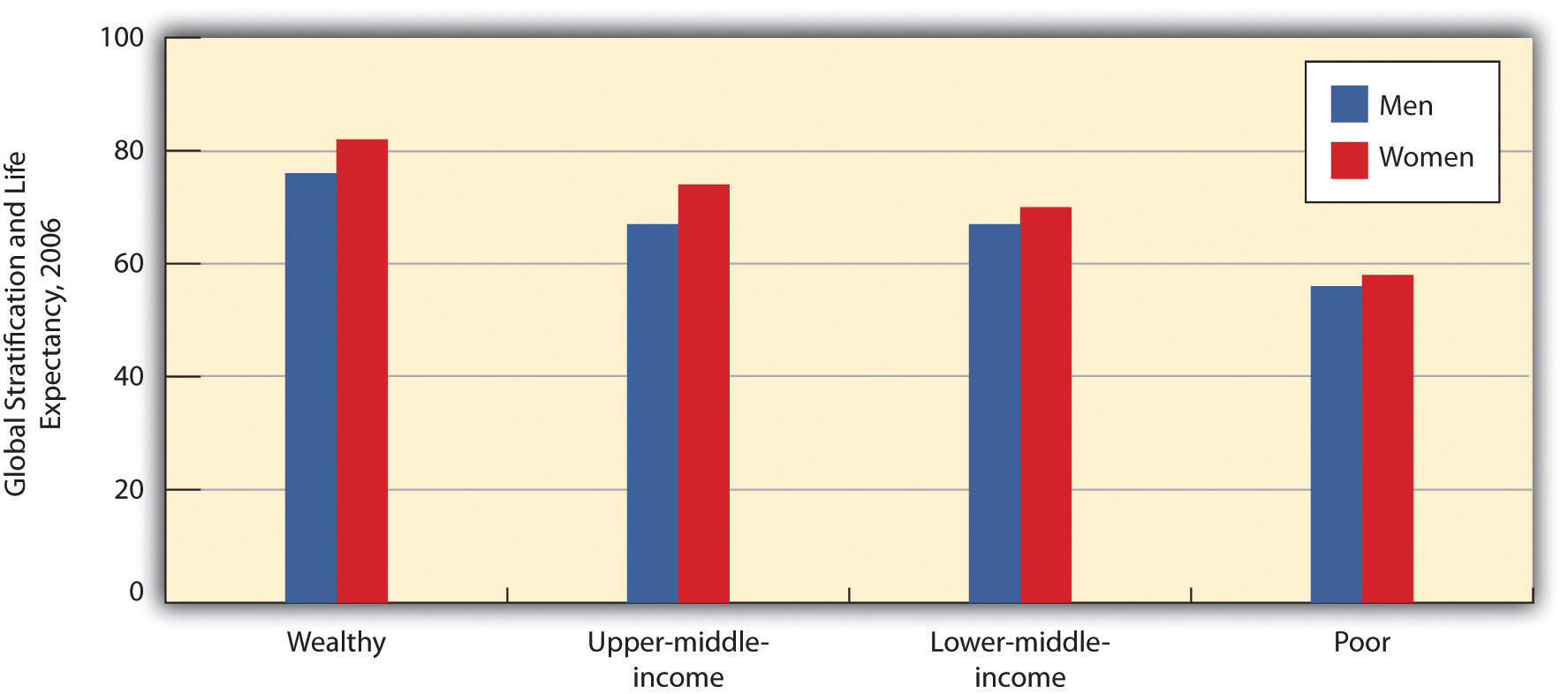
A map of global life expectancy appears in Effigy 9.7 "Average Life Expectancy Across the Globe (Years)". Life expectancy is highest in North America, Western Europe, and certain other regions of the globe and lowest in Africa and Due south Asia, where life expectancy in many nations is some xxx years shorter than in other regions. Another manner of visualizing the human relationship betwixt global poverty and life expectancy appears in Figure ix.viii "Global Stratification and Life Expectancy, 2006", which depicts boilerplate life expectancy for wealthy nations, upper-middle-income nations, lower-middle-income nations, and poor nations. Men in wealthy nations can expect to alive 76 years on boilerplate, compared to but 56 in poor nations; women in wealthy nations tin expect to live 82 years, compared to simply 58 in poor nations. Life expectancy in poor nations is thus 20 and 24 years lower, respectively, for the 2 sexes.
Figure 9.seven Boilerplate Life Expectancy Across the Globe (Years)
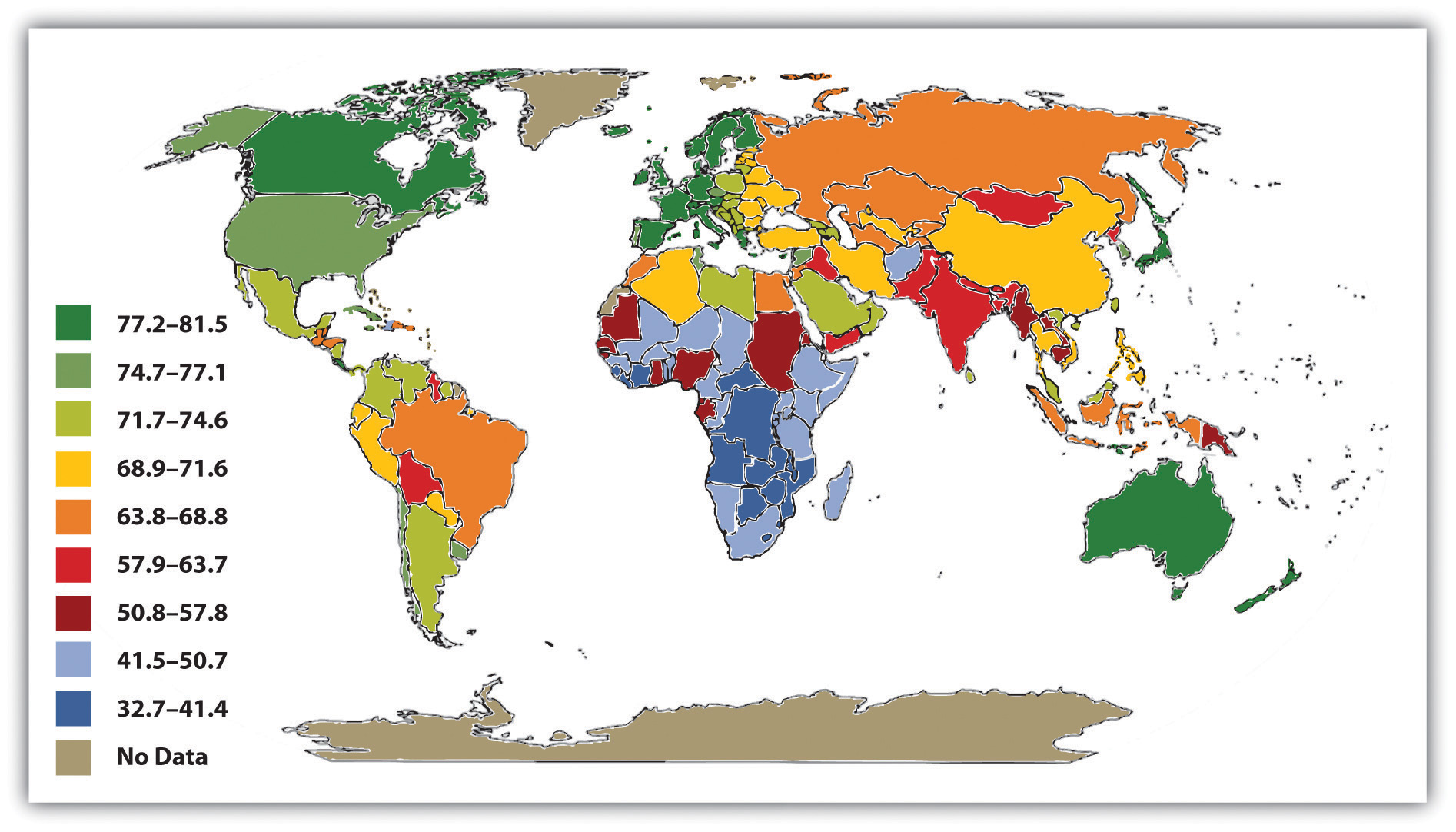
Figure nine.viii Global Stratification and Life Expectancy, 2006
Source: Information from Earth Banking concern. (2009). World development report 2009. Washington, DC: Author.
Child Mortality
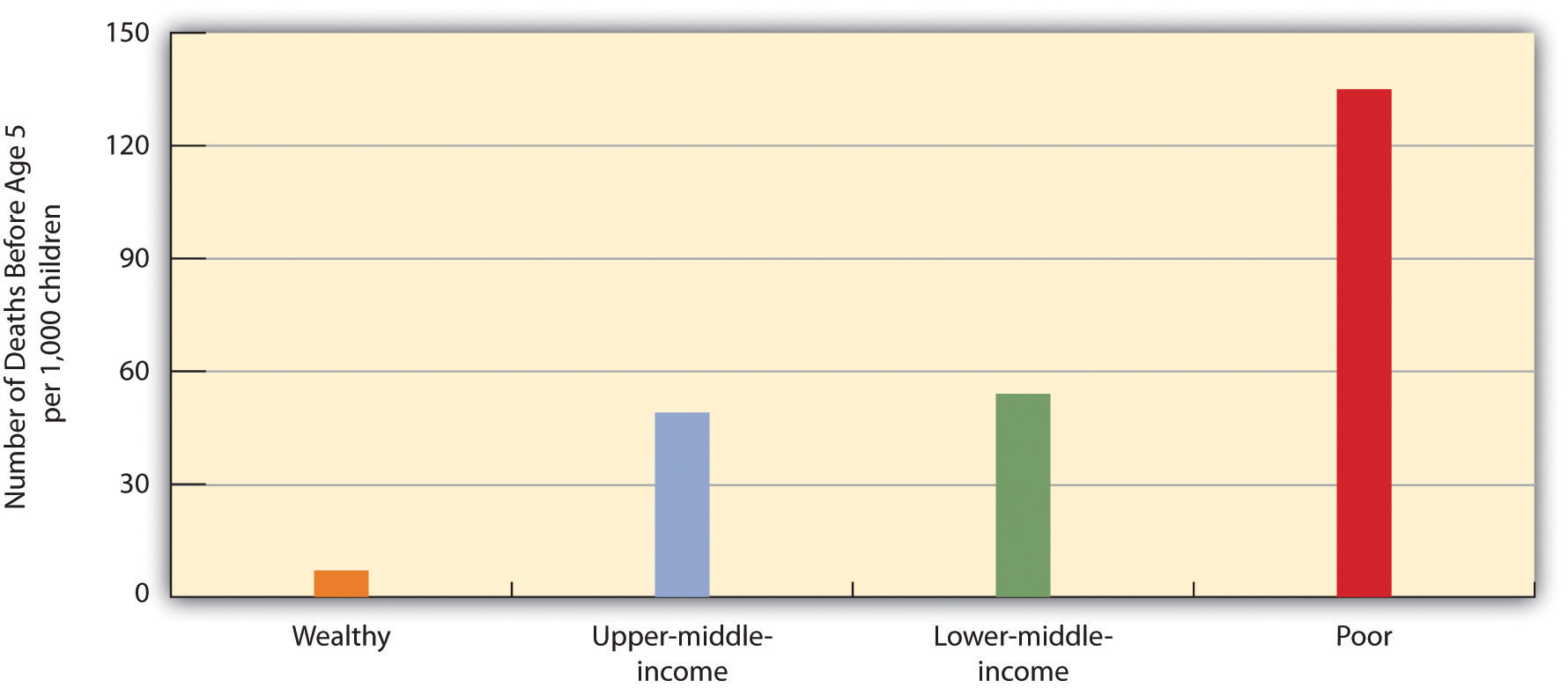
A primal contributor to life expectancy and also a meaning indicator of human development in its own right is kid mortality, the number of children who die before age 5 per 1,000 children. As Figure 9.9 "Global Stratification and Child Mortality, 2006" shows, the rate of kid bloodshed in poor nations is 135 per 1,000 children, meaning that 13.v% of all children in these nations die before historic period v. In a few African nations, child mortality exceeds 200 per 1,000. In dissimilarity, the charge per unit in wealthy nations is only 7 per i,000. Children in poor nations are thus about xix times (13.five ÷ 0.vii) more than likely to dice before age 5 than children in wealthy nations.
Effigy ix.9 Global Stratification and Child Mortality, 2006
Source: Data from Globe Bank. (2009). Earth evolution report 2009. Washington, DC: Author.
Sanitation and Clean Water
Ii other of import indicators of a nation'due south health are access to adequate sanitation (disposal of homo waste) and admission to make clean water. When people lack adequate sanitation and clean water, they are at much greater gamble from life-threatening diarrhea, from serious infectious diseases such as cholera and typhoid, and from parasitic diseases such as schistosomiasis (World Health Organization, 2010). About 2.iv billion people around the earth, most all of them in poor and middle-income nations, practise not take adequate sanitation, and more than than 2 million, nearly of them children, die annually from diarrhea. More than 40 1000000 people worldwide, almost all of them again in poor and eye-income nations, endure from a parasitic infection caused by flatworms.
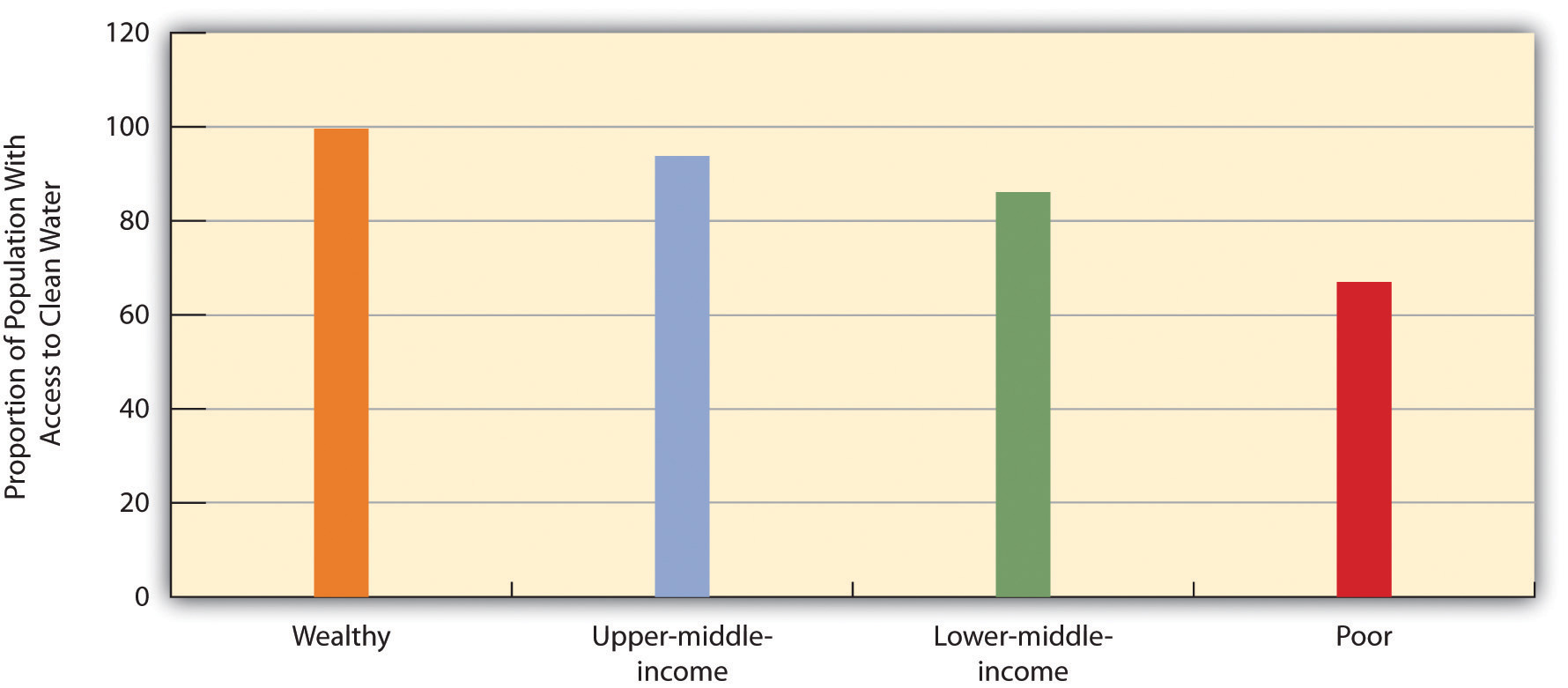
Every bit Figure 9.10 "Global Stratification and Admission to Acceptable Sanitation, 2006" and Figure 9.eleven "Global Stratification and Access to Clean H2o, 2006" evidence, access to adequate sanitation and clean water is strongly related to national wealth. Poor nations are much less likely than wealthier nations to have acceptable admission to both sanitation and clean water. Acceptable sanitation is virtually universal in wealthy nations only is available to only 38% of people in poor nations. Clean h2o is too nearly universal in wealthy nations merely is bachelor to only 67% of people in poor nations.
Figure ix.10 Global Stratification and Admission to Adequate Sanitation, 2006
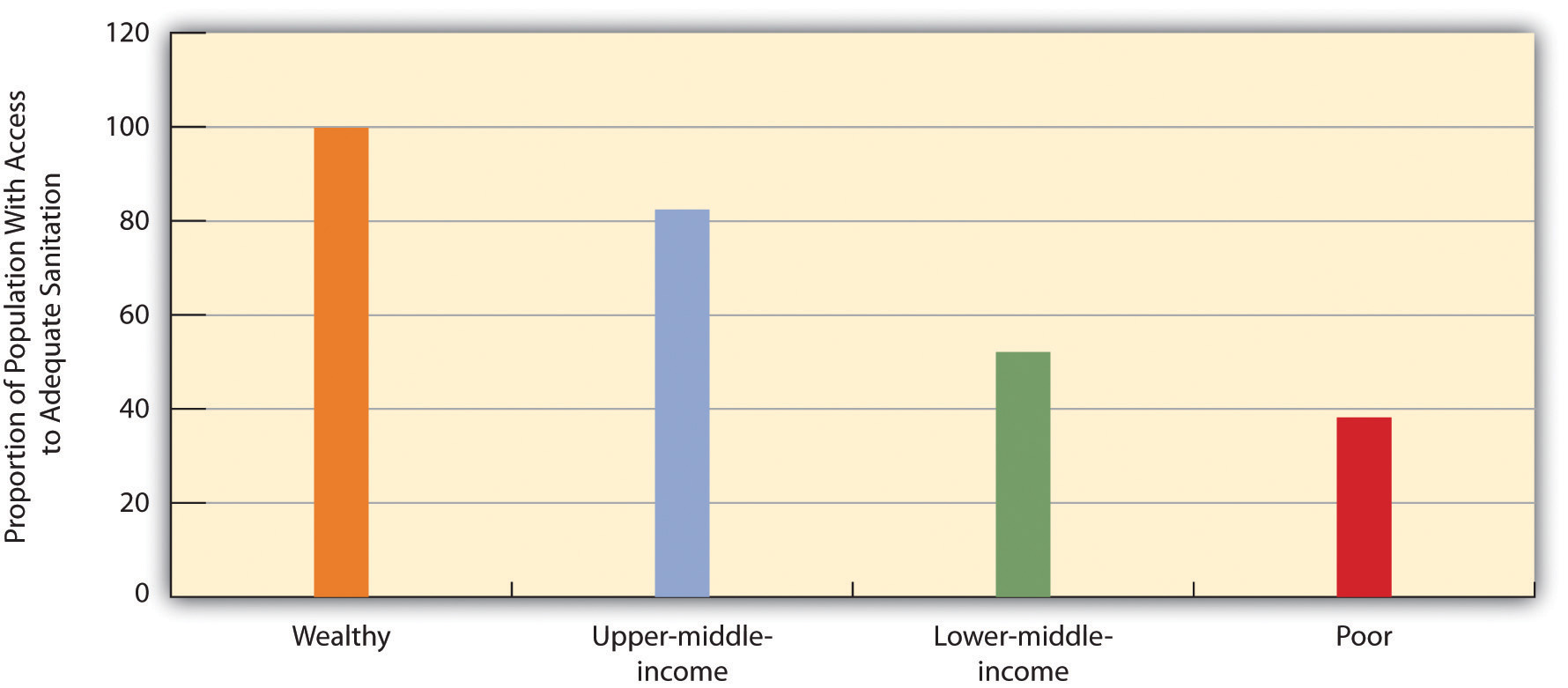
Figure 9.eleven Global Stratification and Admission to Clean Water, 2006
Malnutrition
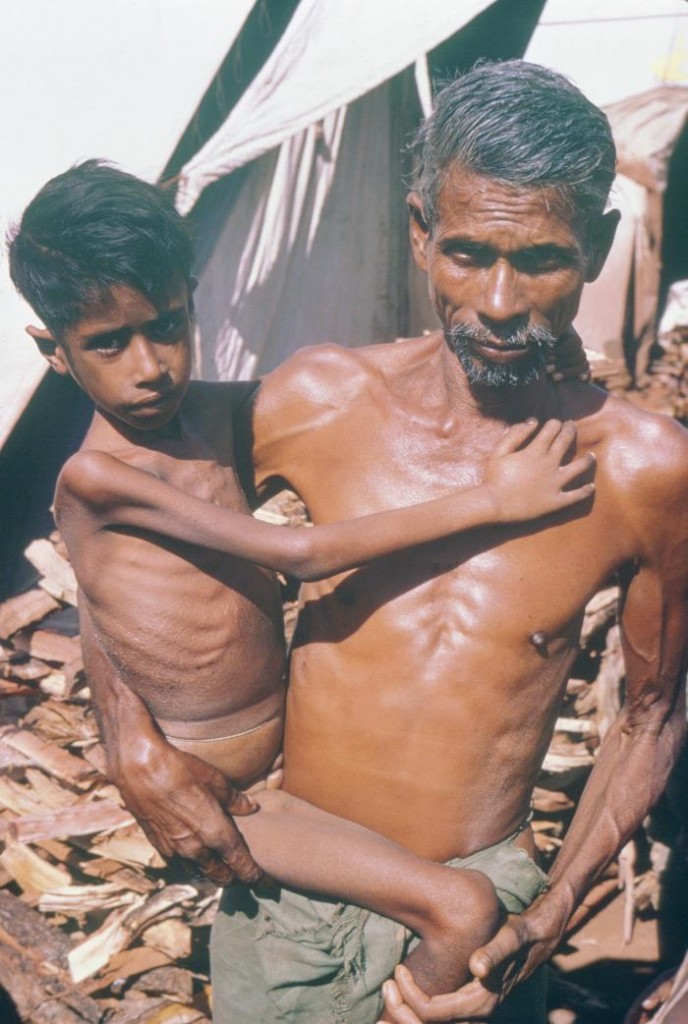
Well-nigh one-fifth of the population of poor nations, some 800 million individuals altogether, are malnourished.
Another health indicator is malnutrition. This problem is caused by a lack of good nutrient combined with infections and diseases such as diarrhea that sap the body of essential nutrients. Near one-5th of the population of poor nations, or well-nigh 800 meg individuals, are malnourished; looking just at children, in developing nations more than than one-fourth of children nether age 5, or nearly 150 million altogether, are underweight. One-half of all these children live in only three nations: Bangladesh, Republic of india, and Pakistan; about half the children in these and other South Asian nations are underweight. Children who are malnourished are at much greater risk for fat and muscle loss, brain damage, blindness, and expiry; perchance y'all have seen video footage of children in Africa or S Asia who are and then starved that they look like skeletons. Not surprisingly, child malnutrition contributes heavily to the extremely high rates of kid bloodshed that we but examined and is estimated to be responsible for more than 5 one thousand thousand deaths of children annually (UNICEF, 2006; World Health Organization, 2010). The "Sociology Making a Departure" box farther discusses the issue of globe hunger.
Folklore Making a Difference
World Hunger and the Scarcity Fallacy
A popular belief is that earth hunger exists because there is too little food to feed too many people in poor nations in Africa, Asia, and elsewhere. Sociologists Stephen J. Scanlan, J. Craig Jenkins, and Lindsey Peterson (2010) phone call this belief the "scarcity fallacy." According to these authors, "The conventional wisdom is that earth hunger exists primarily considering of natural disasters, population pressure, and shortfalls in food production" (p. 35). However, this conventional wisdom is mistaken, as earth hunger stems not from a shortage of food but from the disability to deliver what is actually a sufficient corporeality of nutrient to the earth's poor. Equally Scanlan and colleagues note,
A skillful deal of thinking and research in folklore suggests that world hunger has less to do with the shortage of nutrient than with a shortage of affordable or accessible nutrient. Sociologists accept establish that social inequalities, distribution systems, and other economic and political factors create barriers to food access. (p. 35)
This sociological view has of import implications for how the world should try to reduce global hunger, say these authors. International organizations such as the World Bank and several United Nations agencies have long believed that hunger is due to food scarcity, and this belief underlies the typical approaches to reducing world hunger that focus on increasing food supplies with new technologies and developing more efficient methods of delivering nutrient. Simply if food scarcity is not a problem, and then other approaches are necessary.
Scanlan and colleagues argue that food scarcity is, in fact, not the problem that international agencies and well-nigh people believe it to be:
The bigger trouble with emphasizing food supply as the problem, yet, is that scarcity is largely a myth. On a per capita basis, nutrient is more than plentiful today than whatever other time in human being history.…[E]ven in times of localized production shortfalls or regional famines in that location has long been a global food surplus. (p. 35)
If the trouble is not a lack of food, so what is the problem? Scanlan and colleagues debate that the real problem is a lack of access to food and a lack of equitable distribution of food: "Rather than food scarcity, so, we should focus our attention on the persistent inequalities that frequently accompany the growth in food supply" (p. 36).
What are these inequalities? Recognizing that hunger is especially concentrated in the poorest nations, the authors note that these nations lack the funds to import the arable nutrient that does be. These nations' poverty, then, is one inequality that leads to world hunger, but gender and ethnic inequalities are also responsible. For instance, women effectually the world are more likely than men to suffer from hunger, and hunger is more common in nations with greater rates of gender inequality (every bit measured by gender differences in education and income, among other criteria). Hunger is also more common among ethnic minorities non only in poor nations merely too in wealthier nations. In findings from their ain research, these sociologists add, hunger lessens when nations democratize, when political rights are protected, and when gender and ethnic inequality is reduced.
If inequality underlies earth hunger, they add, then efforts to reduce world hunger will succeed only to the extent that they recognize the importance of inequality in this regard: "To get at inequality, policy must give attention to democratic governance and human rights, fixing the politics of food assistance, and tending to the challenges posed by the global economy" (p. 38). For this to happen, they say, food must be upheld as a "key homo correct." More generally, world hunger cannot be finer reduced unless and until ethnic and gender inequality is reduced. Scanlan and colleagues conclude,
The challenge, in short, is to create a more equitable and only lodge in which food access is ensured for all. Food scarcity matters. However, it is rooted in social conditions and institutional dynamics that must be the focus of any policy innovations that might make a real difference. (p. 39)
In calling attention to the myth of food scarcity and the inequalities that contribute to world hunger, Scanlan and colleagues point to better strategies for addressing this significant international problem. Once once more, sociology is making a deviation.
Adult Literacy
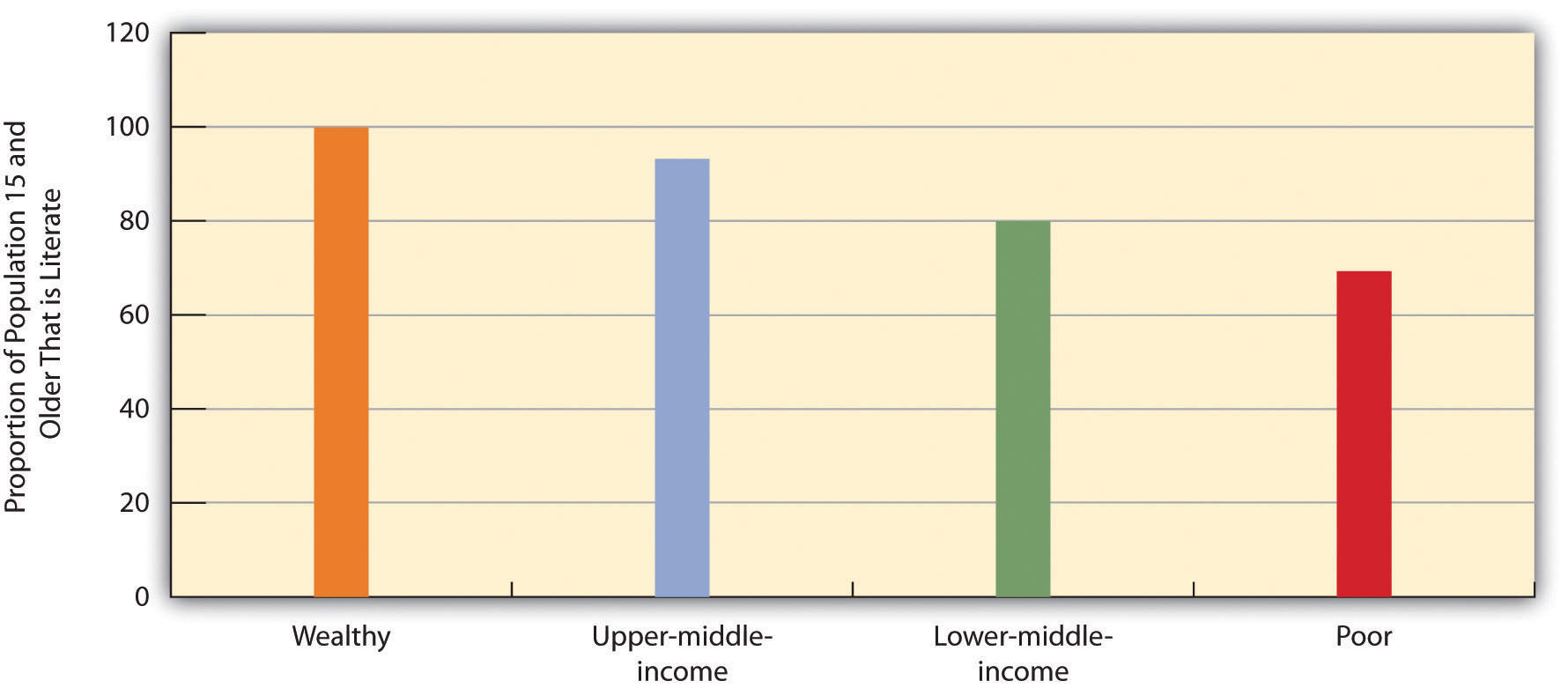
Moving from the area of health, a final indicator of human development is adult literacy, the percentage of people 15 and older who can read and write a simple judgement. Once again we see that people in poor and heart-income nations are far worse off (see Figure ix.12 "Global Stratification and Developed Literacy, 2008"). In poor nations, only virtually 69% of adults 15 and older can read and write a simple sentence. The high charge per unit of illiteracy in poor nations not just reflects their poverty but also contributes to information technology, as people who cannot read and write are obviously at a huge disadvantage in the labor market place.
Figure nine.12 Global Stratification and Adult Literacy, 2008
The states and Uganda
Earlier nosotros leave the issue of homo development, it is instructive to compare the United states, an extremely wealthy nation, with i poor nation from Africa, Uganda, on some economic and human being development indicators every bit presented in Table nine.1 "The United States and Uganda". Every bit will exist obvious, Americans and Ugandans live very different lives, notwithstanding the high degree of poverty establish in the United states compared to other wealthy nations. The typical American lives a comfortable life that the typical Ugandan can only dream of, while the typical Ugandan lives a life that the typical American would discover only in her or his worst nightmare.
Tabular array 9.i The Usa and Uganda
| Usa | Uganda | |
|---|---|---|
| Gross national income per capita ($) | 46,970 | 1,140 |
| Population living beneath $ii per day (%) | — | 76 |
| Infant mortality rate (number of baby deaths per 1,000 live births) | 6.6 | 76 |
| Life expectancy at nativity (years) | 78 | l |
| Lifetime births per woman | 2.1 | vi.7 |
| Underweight children, ages < 5 (%) | i | 20 |
| Motor vehicles per 1,000 population | 787 | vi |
Source: Population Reference Agency. (2009). 2009 earth population information canvass. Washington, DC: Author.
The Status of Women
In discussing stratification in the U.s.a., Chapter eight "Social Stratification" emphasized that women are unduly probable to alive in poverty and ended that poverty "thus has a female face up." What is true in the United states is also true around the globe, only more than and so. Although, every bit we take seen, more 1.4 billion people on earth are desperately poor, their ranks include more than their off-white share of women, who are estimated to make up 70% of the world's poor.
Because women tend to be poorer than men worldwide, they are more probable than men to experience all the problems that poverty causes, including malnutrition and affliction. But they also suffer additional issues. Some of these problems derive from women's physiological role of childbearing, and some arise from how they are treated simply considering they are women.
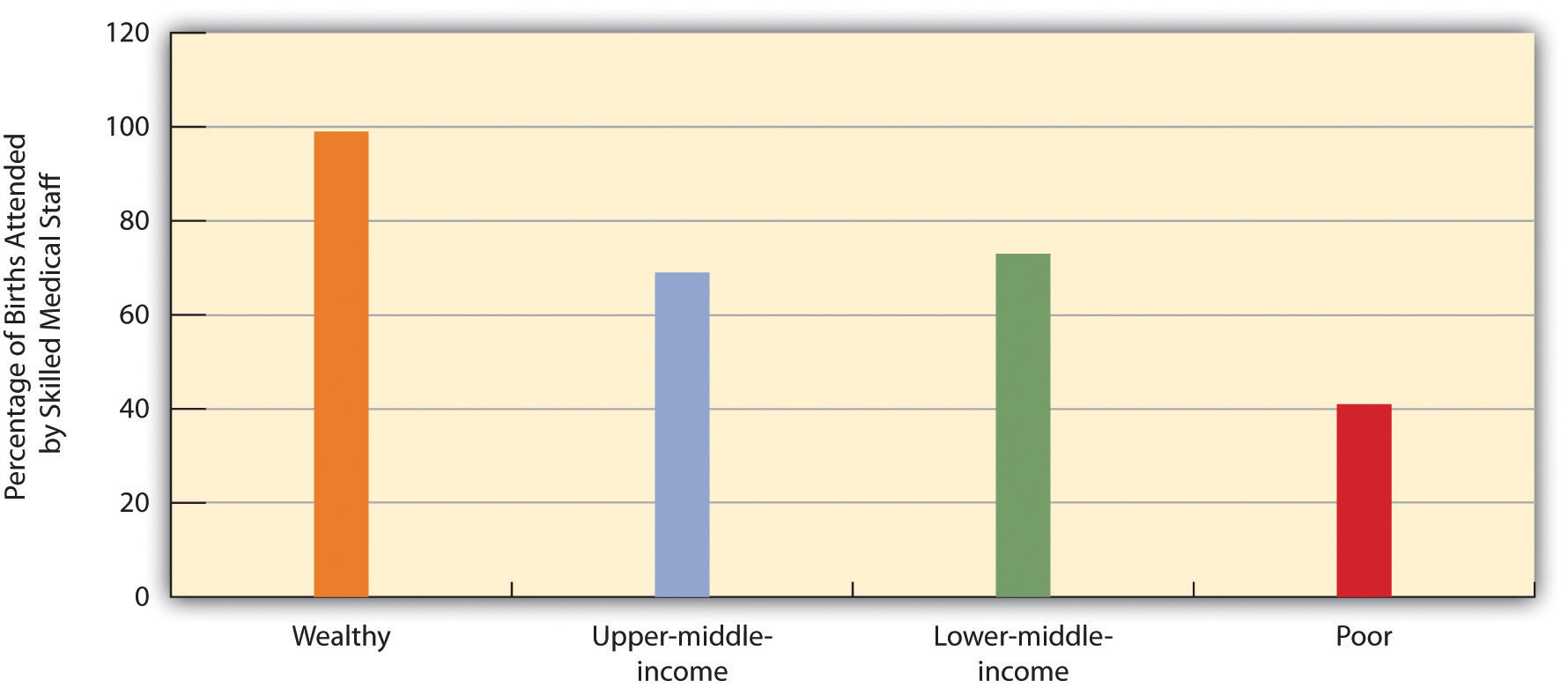
Let's get-go expect at childbearing. Ane of the most depressing examples of how global poverty affects women is maternal mortality, or the number of women who die during childbirth for every 100,000 live births. More than than 500,000 women die worldwide from complications during pregnancy or childbirth. Maternal mortality usually results from one or more of the following: inadequate prenatal nutrition, disease and illness, and junior obstetrical intendance, all of which are much more common in poor nations than in wealthy nations. Figure ix.13 "Global Stratification and Maternal Mortality, 2005" shows the deviation that national poverty makes for maternal mortality. In wealthy nations, the rate of maternal mortality is a minuscule x per 100,000 births, but in poor nations the rate is a distressingly loftier 790 per 100,000 births, equivalent to nigh i death for every 100 births. Women in poor nations are thus 79 times more probable than those in wealthy nations to die from complications during pregnancy or childbirth. Figure 9.14 "Global Stratification and Medically Assisted Births, 2000–2007" suggests a reason for this divergence, as it shows that births in poor nations are less than half every bit likely every bit those in wealthy nations to be attended by skilled medical staff.
Figure 9.13 Global Stratification and Maternal Mortality, 2005
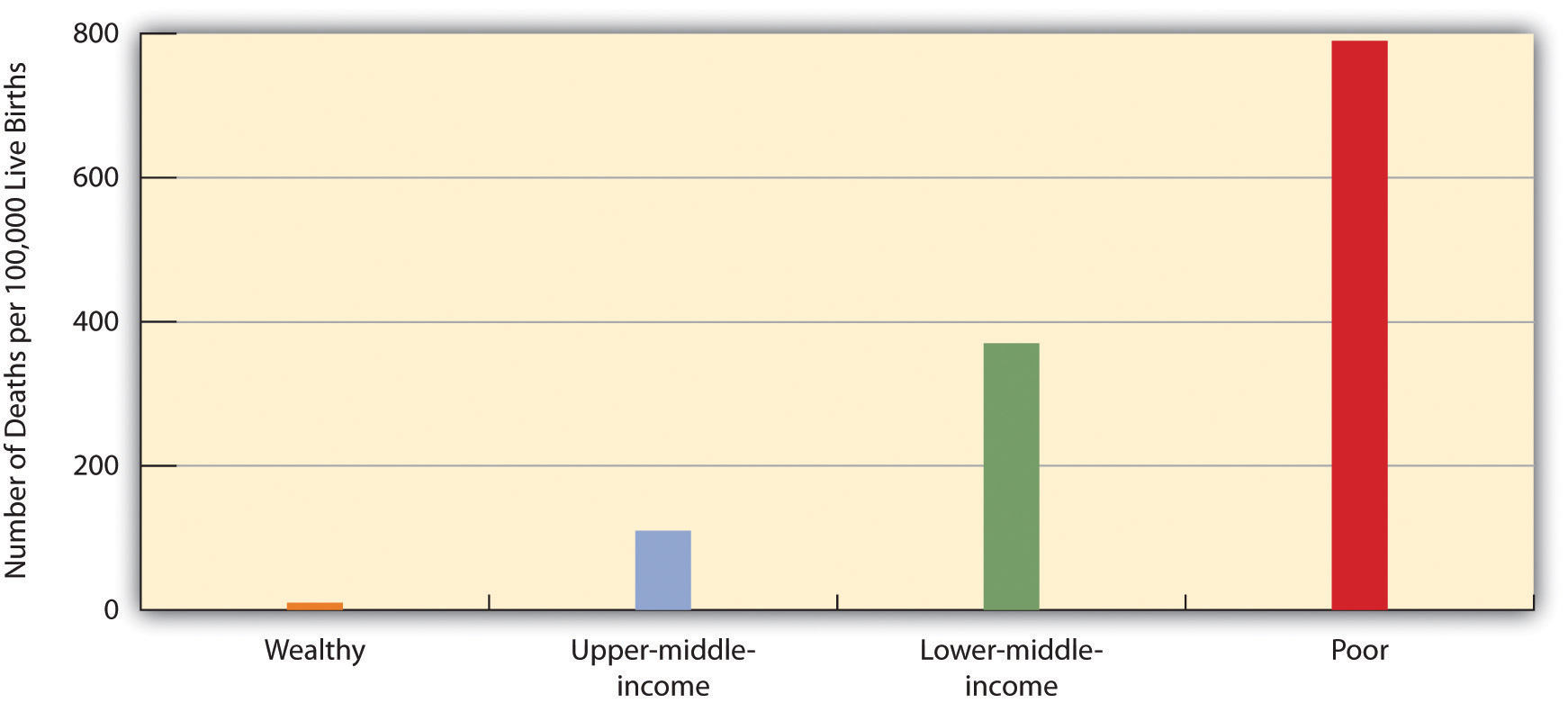
Figure 9.14 Global Stratification and Medically Assisted Births, 2000–2007
In addition to these problems, women in poor nations fare worse than men in other ways because of how they are treated every bit women. I manifestation of this fact is the violence they experience. About one-third of women worldwide have been raped or browbeaten, and Immunity International (2004) calls violence against women "the greatest human rights scandal of our times." Although violence against women certainly occurs in wealthy nations, it is more mutual and farthermost in poor and center-income nations. More than one-half of women in Uganda, for case, have been physically or sexually abused (Amnesty International, 2010). In Republic of india and Pakistan, thousands of women are killed every yr in dowry deaths, in which a new wife is murdered by her husband and/or his relatives if she does non pay the groom money or appurtenances (Kethineni & Srinivasan, 2009).
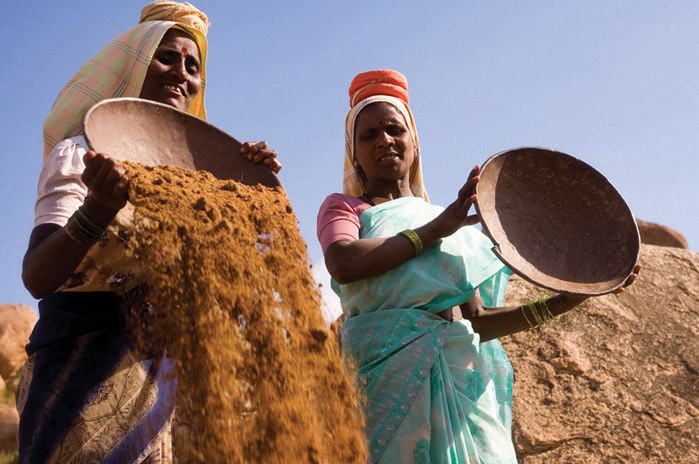
In Bharat and Islamic republic of pakistan, thousands of new wives every year are murdered in dowry deaths because they have not provided their husbands a suitable corporeality of money and goods.
Beyond violence, women in poor nations are less likely than their male counterparts to get a higher education, and girls are less probable than boys to nourish principal school. Women are as well less likely than men to work in jobs that pay a decent wage and to hold political function. In many poor nations, girls are less likely than boys to receive adequate medical care when they go ill and are more probable than boys to die before historic period 5. In all these means, women and girls in poor nations especially suffer.
The United Nations Development Programme (UNDP) uses a gender empowerment measure (GEM) to determine the status of women compared to men in nigh half the nations across the world. This measure is based on such things as the percentage of national legislative seats and professional and technical jobs held by women and the ratio of female person-to-male earned income. In the UNDP'south 2009 Human Development Report, the nations with the five highest Gem rankings were Sweden, Norway, Finland, Denmark, and the netherlands (the United states ranked only 18th), all very wealthy nations; the nations with the v everyman Jewel rankings were Yemen, Bangladesh, Egypt, Saudi arabia, and Algeria.
All these latter nations are very poor with the exception of Saudi arabia, which is fairly wealthy. Notwithstanding, women in Kingdom of saudi arabia are not allowed to drive a auto or to vote. Each woman must have a male relative who acts equally her legal guardian; a woman cannot work exterior the home or travel outside the land without her guardian's permission. The two sexes are segregated in public: women have women-just stores to store in and women-simply lines in fast-nutrient restaurants to stand in. Law enforcement agents watch advisedly to make sure that the sexes exercise not interact in public (Zoepf, 2010).
2 sets of international statistics cited by writers Nicholas D. Kristof and Sheryl WuDunn (2009) are especially troubling. Because women outlive men, ordinarily in that location should be more than females than males in a country. Still China has 107 males for every 100 females, and India has 108 males for every 100 females. In these nations, girls and women accept died at far greater numbers than men because of abuse, murder, and lack of health intendance, only because they are female. It is estimated that the number of "missing women" in the globe today because of these issues is between sixty million and 107 million.
A second ready of statistics concerns sexual slavery. As Kristof and WuDunn (2009, p. MM28) summarize this problem,
In the developing world,…millions of women and girls are actually enslaved. While a precise number is difficult to pin down, the International Labor System, a U.N. bureau, estimates that at any 1 fourth dimension there are 12.iii meg people engaged in forced labor of all kinds, including sexual servitude. In Asia alone well-nigh one 1000000 children working in the sex trade are held in weather condition indistinguishable from slavery, according to a U.N. report. Girls and women are locked in brothels and beaten if they resist, fed but enough to exist kept alive and oftentimes sedated with drugs—to pacify them and often to cultivate addiction.
This situation is so horrid that Kristof and WuDunn (2009, p. MM28) phone call for a moral cause to salve women's lives. "In the 19th century," they write, "the paramount moral claiming was slavery. In the 20th century, information technology was totalitarianism. In this century, information technology is the brutality inflicted on and then many women and girls around the globe: sex activity trafficking, acid attacks, bride burnings and mass rape." They add that an important reason for global poverty is that women in poor nations are uneducated, victimized by violence, and generally oppressed. For this reason, they say, international organizations are increasingly recognizing that "focusing on women and girls is the most effective way to fight global poverty."
The Status of Children
Considering of their size, immaturity, and lack of resources, children are considered the weakest members of any order. When nosotros look around world, we come across that this fact of life is also truthful of the global lodge. In poor nations, children especially endure. Nosotros have already seen evidence of this suffering in this affiliate'due south earlier give-and-take of babyhood disease, malnutrition, and mortality.
International agencies guess that 8.8 meg children under age 5 died in 2008 across the globe, or an average of about 24,000 child deaths every mean solar day (You, Wardlaw, Salama, & Jones, 2010). In sub-Saharan Africa, 1 of every 7 children dies before age 5; in Southern asia, i of every thirteen children dies earlier age v. Three-fourths of all child deaths occur in only 18 countries, and half of all child deaths occur in only 5 countries: China, the Congo-kinshasa, India, Nigeria, and Pakistan. Diarrhea and pneumonia cause many of the child deaths, of which about twoscore% occur during the starting time calendar month of life. The weather condition discussed before, including inadequate sanitation and lack of access to make clean water, account for the bulk of fatal disease that children suffer.
If almost 9 million children under age 5 die annually, other numbers also tell an unsettling tale (UNICEF, 2009):
- 148 million children under age 5 are underweight for their historic period;
- 101 million children, including more girls than boys, practise non attend simple school;
- 22 million children are not immunized against common diseases;
- 4 million infants die before reaching the historic period of 1 month;
- 500 million to 1.5 billion children have been exposed to violence or are victims of violence;
- 150 million children anile five–fourteen are engaged in child labor;
- 145 million children take had one or both of their biological parents die;
- 70 1000000 girls have experienced genital mutilation; and
- 1.2 million children are victims of trafficking, taken from their parents and subjected to kid labor and sexual slavery.
As agonizing every bit these statistics might be, there is also good news, equally much progress has been made during the past few decades in helping the world's children, thank you to agencies such as UNICEF. For example, child bloodshed worldwide declined from 142 per 1,000 live births in 1970 to 65 per one,000 in 2008; the rate in Africa declined from 231 to 132. Reflecting this decline, the number of child deaths dropped from 16.7 meg in 1970 to 8.viii meg in 2008. International efforts have saved millions of children's lives during the past four decades.
Before we go out the effect of children's welfare, it is worth noting i boosted problem they face in certain parts of the world. In some developing countries, children are taken by force to bring together the armed forces or armed groups, or they join out of economic necessity or to escape abuse. These "child soldiers" may bear arms and engage in gainsay, serve as cooks and messengers, or be sexual slaves. Approximately 300,000 children (under age 18) worldwide are idea to be child soldiers. Beyond the dangers of being involved in arm conflict, these children are not in school and are often sexually abused. Since the 1980s, UNICEF and other international agencies have worked for the release of child soldiers in many nations, including Angola, Republic of burundi, the Democratic Republic of the Congo, Rwanda, Somalia, and Republic of uganda.
Key Takeaways
- Global poverty has a devastating impact. Poor nations suffer tremendously on human development indicators such as health, educational activity, and mortality.
- Women in poor nations fare much worse than men in these nations. They are victims of violence and other abuse because they are women, and they are less likely to attend school and more likely to be poor.
- Children in poor nations are much more probable than those in wealthy nations to die before age five and to suffer from malnutrition and disease.
For Your Review
- Considering all the means in which poor nations fare much worse than wealthy nations, which one seems to you lot to be the most of import problem that poor nations experience? Explain your respond.
- Some scholars attribute global violence against women to women'southward general inequality, and some scholars attribute it to men's biological nature. Why exercise you lot call back global violence against women is and then common?
References
Immunity International. (2010). "I tin can't afford justice": Violence against women in Republic of uganda continues unpunished and unchecked. London, England: Author.
Amnesty International. (2004). It'due south in our easily: Stop violence against women. Summary. London, England: Author.
Kethineni, Southward., & Srinivasan, M. (2009). Police handling of domestic violence cases in Tamil Nadu, India. Journal of Contemporary Criminal Justice, 25, 202–213.
Kristof, N. D., & WuDunn, Due south. (2009, August 23). The women's crusade. The New York Times, p. MM28.
Scanlan, S. J., Jenkins, J. C., & Peterson, L. (2010). The scarcity fallacy. Contexts, 9(ane), 34–39.
UNICEF. (2006). Progress for children: A report carte on diet. New York, NY: Author; World Health Organization. (2010). Children'due south environmental wellness. Retrieved from http://www.who.int/ceh/risks/cehwater2/en/index.html.
UNICEF. (2009). The state of the world's children: Special edition. New York, NY: Author.
World Health Organization. (2010). Children's environmental health. Retrieved from http://www.who.int/ceh/risks/cehwater2/en/index.html.
Yous, D., Wardlaw, T., Salama, P., & Jones, G. (2010). Levels and trends in under-5 mortality, 1990–2008. Lancet, 375(9709), 100–103.
Zoepf, K. (2010, June 12). Fighting for the right to accept limited rights. The New York Times, p. A7.
Source: https://open.lib.umn.edu/sociology/chapter/9-2-the-impact-of-global-poverty/
0 Response to "in most poor nations of the world today, what is the average number of children born to a woman?"
Publicar un comentario